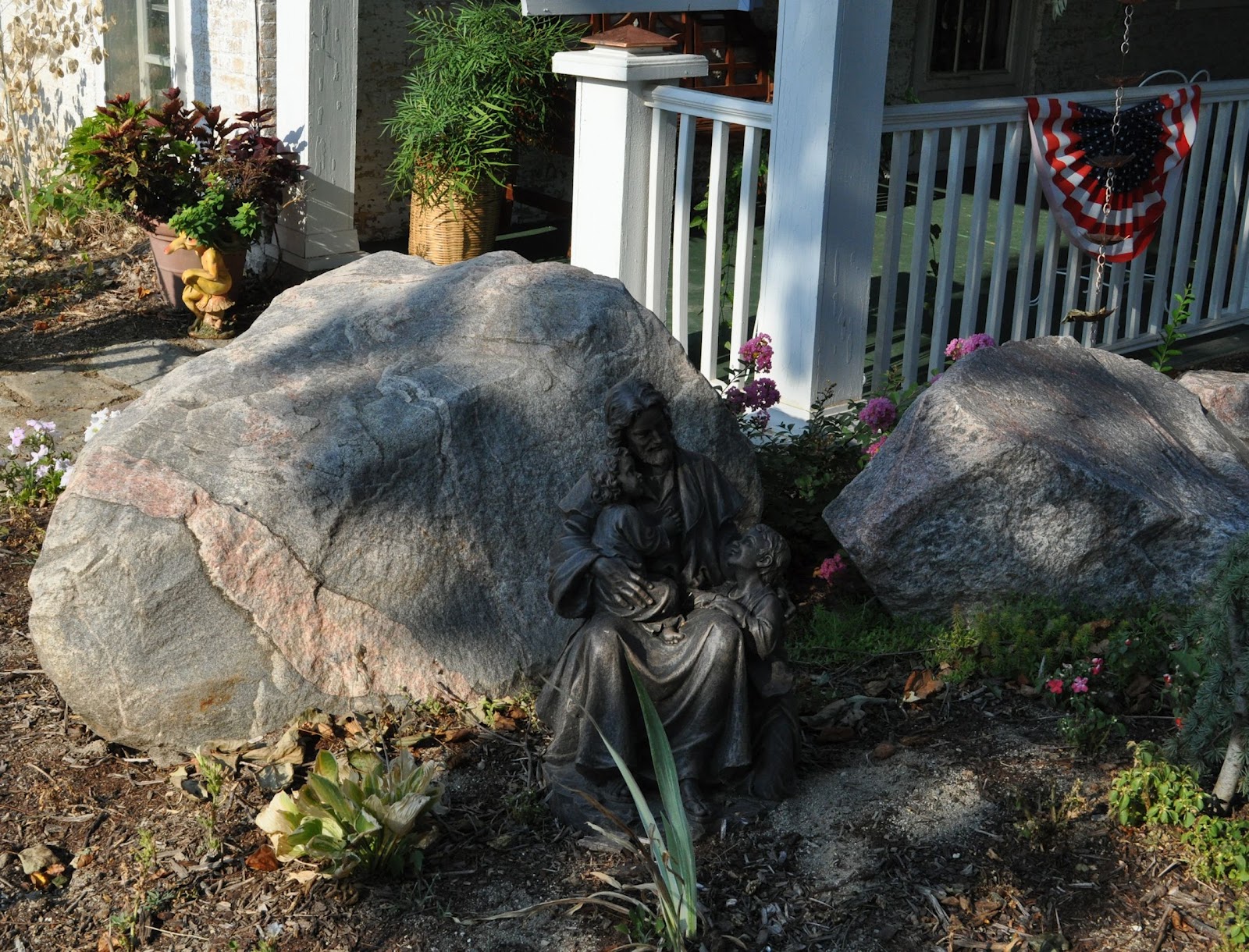
I took a few minutes today, just a few, to enjoy the shapes and colors in the garden. This salutary practice is contrary to the doctrine of "the overwhelmed landscaper," a class of people who tend to bite off more than they can chew and then gripe about it with their mouths full. Epic yardwork projects are a way of life for the overwhelmed gardener. Since we're not camping out on a ten-year siege of Troy, and since no bard is available to sing of our anger, feasting, or hideous death by pitiless bronze, we make plans we have little hope of seeing through and then, quite late, and incompletely, see them through on a landscape.
My back aches.
We have designed our gardens to delight us with form and color before the main season of the daylilies, which occupy most of the garden space on this acre and a half. Just today I noted the beginning of daylily season with the opening of the charming miniature flower named Bitsy. It was a Father's Day present to me from my late wife back in 1992. We lived in Hyde Park, Vermont then, and our favorite place to discover and buy plants was the Cady's Falls Nursery in the tiny hamlet adjoining Hyde Park village. That's where San bought Bitsy for me. Don Avery was reluctant to carry it because its foliage coming out of winter looked a little ratty. Ratty looking daylilies don't sell until they grow better leaves.
So I've grown Bitsy for twenty years. I hope for twenty more.
Bitsy is sited on the near corner of one of the beds we see down below us while sitting on the deck or looking out the dining room slider as we make breakfast, lunch, or dinner. It's a lucky break that the garden phlox I planted next to Bitsy also came into bloom this week.
Typical of the driveway of the overwhelmed landscaper is an array of potted plants not yet planted. The zinnias and yarrows below have been on the driveway for a full week now.
The name of that zinnia is "Inca."
On the other side of the driveway there are small zinnias to accompany several other yarrows, and they are actually planted!
This past week marked the beginning of our annual poppy season. Two years ago on May 27, my Wichita friend, Linda Farris posted to the daylily Robin about her annual poppies. Here is what she said:
"I decided to stay home and play in my own yard this weekend. Here at Fieldstone Cottage there is always another bed to weed or more plants to set in. Still blooming strongly are magnificent double pink and red poppies which form huge swaths of coral pink or intense red in whatever bed they rest. These pinks were heritage-bred poppy seed from the Ukraine, brought to this country with Russian Mennonite immigrants some 150 years ago.
"My original seeds years ago were a gift from a Mennonite descendant and thrown out over a December snow-covered flower bed. Imagine my total surprise when they sprouted in February, grew to enormous mass in April, and bloomed with vigor in May and June. They are a jaw-dropping sight.
"My red poppies were a gift from above. I'm guessing that a single seed must have come in on a load of compost from our community recycle center, as one year a single red poppy plant appeared in a pink poppy patch that was mulched the previous fall with community compost. The robust red double poppy plant made tremendous seeds, which I saved and cast out the following winter in its own huge bed. As they are self seeding, I now have a 30 x 175 foot bed filled every year with these red beauties.
"My pink bed covers a 16 x 40 foot area in front of our
home."
Here is the pink poppy we started last year from seeds Linda sent us. This one must have germinated last fall, as all the others are much shorter.
The Siberian Irises also bloom with the peonies at the end of may. This one is Light of Heaven.
Amber White is a Siberian iris we received as a gift from the renowned daylily hybridizer, Mike Huben, when we spoke to the New England Daylily Society in October of 2011.
The smoke bushes at the lakeside are at their most colorful in late May, just as the knockout roses come into bloom.
To the left of that scene, a Crimson Pygmy Barberry bush provides a reddish purple accent in a circular bed of daylily foliage and emerging poppies.
What is overwhelming the landscaper, who feels five weeks behind right now, is the epic project of moving the selected daylily seedlings into a new bed on less sloped ground so that he can rework the terrible soil in the old bed and plant his new daylily seedlings there. He (me) is digging a hole for each transplant and is mixing two shovelfuls of compost into the dirt of each hole. The process of transplant entails inspecting each plant for its habit of growth and dividing it if there are a lot of fans growing tightly together. This is the smallest of three sections of the new bed, and I mulched it this morning.
An important feature of late May for a daylily collector in St. Peters is the coming into bloom of the daylilies that arrived from sellers in the deep south. I bought over two hundred new daylilies, a record for me and the main reason I'm overwhelmed. Today, my favorite of the southern bloomers is Cat's Eye by the Mississippi hybridizer, James Townsend.
I took this picture at noon, but the flower was open perfectly after a cool night when I went out at eight this morning. I love everything about this face! Just thinking of it makes me stop whining!
Showing posts with label Daylilies. Show all posts
Sunday, May 26, 2013
Saturday, October 6, 2012
Structures
We're into another phase of remodeling the house. There's nothing more to do this season in the gardens except continue to weed them and apply Preen before the winter weeds germinate. The Henbit has already begun to appear, so the time for action is now!
Our "big" summer project was shaping up the raised beds for vegetables. This is the view of the back yard Left a week ago, the cool weather crops having sprouted.
Three weeks ago on a Sunday morning I finished the "small" summer project of contouring the ground in the middle of the back yard so that water flowing downhill from the house would not pool in the area of the circular bed in the picture below.
I killed the grass around the circle and spent several work sessions shaving dirt away to make a shallow trough that tilts toward the dock. The last step was four car trips to the local nursery to bring back half a pallet of fescue sod and lay it on the shaped earth. I finished that before lunch and watered it well. You can make out small white flags I put at the edges of the new sod so that the man who mows our lawn knows where not to bring the machine. Machinery at this stage would dislodge the small pieces around the curves. We need to let roots penetrate the ground and fasten the sod before we use a mower there.
Here's my favorite structure outside, a new seedling of mine with a winsome face.
This is the last flower on the first scape produced by my seedling number 12-25, meaning it is the 25th seedling I've given a number in 2012. In 2011 I assigned 250 numbers and decided to keep the best 85. The crazy weather of 2012 depressed the bloom in my new seedling beds and I had very little to look at. I can't wait to see this next summer!
Here is a seedling I've had in the garden for four years, number 08-55.
This was blooming on its second scape earlier this week when I took the picture on a cool morning. There is nothing distinctive about the face of this flower. What's interesting to me is that the patterned eye of FANTASY EYES, the pollen parent, was passed to this child by way of a toothy pod parent, ROMANTIC STARES, which seems to lack a patterned eye.
I chose ROMANTIC STARES as a parent because it is Dormant, has good plant structure, is fertile both ways, and is a child of ANGEL'S SMILE, which is known to encourage jazzy results in the eyezone. Here is ROMANTIC STARES.
There is only a hint of that jagged edge on my seedling, but the eye is more interesting. Here is FANTASY EYES.
You can see that there are subtle rings of blue violet color in the eye, and there's an edge with two colors. The thing about my seedling that is most interesting to me is the structure of its scape. Here is a picture of its second scape, a rebloom that began in late September. Notice the wide branching extending down the scape and the beautiful presentation of the flowers.
I want to breed this seedling to other patterned flowers in the hopes of retaining the healthy plant and well-formed scape. On the right edge of the picture you might be able to see the top of a third scape coming along in the hopes of blooming before Halloween. We'll probably have a frost before that scape can bloom.
Our "big" fall project is the remodeling of the front entrance of our house. We knew when we bought the house that the front door didn't suit the design of the house. The windows belong on some other kind of house and we don't care for double doors. We've ordered a single door with two sidelights. As long as we were correcting the door, Kathy designed a new front set of steps and a small patio, with planters extending out on either side. We are using the same blocks as we've used on the wall around our car park area and the same pavers we used on the patio in back.
After removing eight inches of dirt and more than a hundred pounds of old tree roots, Steve Brandt and his helper Tim Yankow worked on building footers to support the rows of blocks that will surround two wide landings before a third step down to the level of the sidewalk.
They removed a large concrete step and found a large void under the existing landing. Here's Tim pushing gravel up into that void. Steve is on the left inspecting the first section of the first landing. Before they finished filling the void, they pushed two blocks under the front of the landing to provide additional support.
Steve spent a lot of time getting the level of the first course of blocks perfect. Everything else goes much faster if the foundation is correct. Here's where they stopped Thursday as the rains moved in.
They will put pavers on top of the existing bricks on the top landing to finish that part of the project, but first they will have to address the fact that the existing landing is not quite level.
They've already laid out the foundation row for the front edge of the next landing down. It will be a step down from the top of about five and a half inches. We wanted three shallow steps rather than two of standard height. The second landing will come out to where the grass is and will be about five and a half inches above the sidewalk. That piece of sidewalk you see on the left will be cut away to make room for the final landing.
The new door is expected in about two weeks, so its arrival should coincide with the completion of the stonework.
This is not the final project we have in mind. I you look again at the dock at the top of this post, you'll see how decrepit it is. Kathy will design its replacement over the winter. It will probably be a summer project, when the lake is at its lowest level.
Our "big" summer project was shaping up the raised beds for vegetables. This is the view of the back yard Left a week ago, the cool weather crops having sprouted.
Three weeks ago on a Sunday morning I finished the "small" summer project of contouring the ground in the middle of the back yard so that water flowing downhill from the house would not pool in the area of the circular bed in the picture below.
I killed the grass around the circle and spent several work sessions shaving dirt away to make a shallow trough that tilts toward the dock. The last step was four car trips to the local nursery to bring back half a pallet of fescue sod and lay it on the shaped earth. I finished that before lunch and watered it well. You can make out small white flags I put at the edges of the new sod so that the man who mows our lawn knows where not to bring the machine. Machinery at this stage would dislodge the small pieces around the curves. We need to let roots penetrate the ground and fasten the sod before we use a mower there.
Here's my favorite structure outside, a new seedling of mine with a winsome face.
This is the last flower on the first scape produced by my seedling number 12-25, meaning it is the 25th seedling I've given a number in 2012. In 2011 I assigned 250 numbers and decided to keep the best 85. The crazy weather of 2012 depressed the bloom in my new seedling beds and I had very little to look at. I can't wait to see this next summer!
Here is a seedling I've had in the garden for four years, number 08-55.
This was blooming on its second scape earlier this week when I took the picture on a cool morning. There is nothing distinctive about the face of this flower. What's interesting to me is that the patterned eye of FANTASY EYES, the pollen parent, was passed to this child by way of a toothy pod parent, ROMANTIC STARES, which seems to lack a patterned eye.
I chose ROMANTIC STARES as a parent because it is Dormant, has good plant structure, is fertile both ways, and is a child of ANGEL'S SMILE, which is known to encourage jazzy results in the eyezone. Here is ROMANTIC STARES.
There is only a hint of that jagged edge on my seedling, but the eye is more interesting. Here is FANTASY EYES.
You can see that there are subtle rings of blue violet color in the eye, and there's an edge with two colors. The thing about my seedling that is most interesting to me is the structure of its scape. Here is a picture of its second scape, a rebloom that began in late September. Notice the wide branching extending down the scape and the beautiful presentation of the flowers.
I want to breed this seedling to other patterned flowers in the hopes of retaining the healthy plant and well-formed scape. On the right edge of the picture you might be able to see the top of a third scape coming along in the hopes of blooming before Halloween. We'll probably have a frost before that scape can bloom.
Our "big" fall project is the remodeling of the front entrance of our house. We knew when we bought the house that the front door didn't suit the design of the house. The windows belong on some other kind of house and we don't care for double doors. We've ordered a single door with two sidelights. As long as we were correcting the door, Kathy designed a new front set of steps and a small patio, with planters extending out on either side. We are using the same blocks as we've used on the wall around our car park area and the same pavers we used on the patio in back.
After removing eight inches of dirt and more than a hundred pounds of old tree roots, Steve Brandt and his helper Tim Yankow worked on building footers to support the rows of blocks that will surround two wide landings before a third step down to the level of the sidewalk.
They removed a large concrete step and found a large void under the existing landing. Here's Tim pushing gravel up into that void. Steve is on the left inspecting the first section of the first landing. Before they finished filling the void, they pushed two blocks under the front of the landing to provide additional support.
Steve spent a lot of time getting the level of the first course of blocks perfect. Everything else goes much faster if the foundation is correct. Here's where they stopped Thursday as the rains moved in.
They will put pavers on top of the existing bricks on the top landing to finish that part of the project, but first they will have to address the fact that the existing landing is not quite level.
They've already laid out the foundation row for the front edge of the next landing down. It will be a step down from the top of about five and a half inches. We wanted three shallow steps rather than two of standard height. The second landing will come out to where the grass is and will be about five and a half inches above the sidewalk. That piece of sidewalk you see on the left will be cut away to make room for the final landing.
The new door is expected in about two weeks, so its arrival should coincide with the completion of the stonework.
This is not the final project we have in mind. I you look again at the dock at the top of this post, you'll see how decrepit it is. Kathy will design its replacement over the winter. It will probably be a summer project, when the lake is at its lowest level.
Friday, July 27, 2012
Holmes, Holmes on the Range
I've known Mike and Sandy Holmes via email since early in 2011, when I got involved in testing and working on the help desk for the AHS Membership Portal, a participatory web site for daylily lovers who are members of the American Hemerocallis Society. Mike and Sandy were the keystones, if there can be more than one, on the design and technical side of the project.
Yawn, I hear you say, so here's a picture to get things rolling. This daylily is numbered C860. I saw it in the Holmes garden on July 12 during an added day of garden touring in the Dayton area before the AHS Convention kicked off in Columbus. Mike and Sandy are both fine hybridizers, and I wish I could say which one of them created this beautiful seedling which was marked in the garden for awards judges' consideration for the Junior Citation Award.
The J.C. award is reserved for distinctive seedlings of exceptional merit in every observable regard. It requires the vote of ten awards judges, who are advised in the voting rules to "walk on by" and stop evaluating if they can't say why the seedling is distinctive, meaning something that represents an advance in hybridizing daylilies.
It's not just the color, form, or pattern on the flower. There may be distinction in the health of the plant's foliage, in the spacing and number of branches on the stem, on the apparent rate of increase, or on the "floral presentation," which is what got my eye when I took this picture. Three flowers open in the same visual plane without crushing each other. Good color retention on a hot day after lunch.
I'm sure that more than ten judges saw that seedling on the day I was there, so it will be interesting to see if it pulls in the votes. There were other fine seedlings up for J.C. votes in the Holmes garden as well as in the Polston garden earlier in the day, so we judges had a lot to remember and consider, not to mention the seedlings we see in our own regions.
Here's a look at Mike and Sandy's "plantation" as I stepped off the tour bus.
An even larger area to the left of this picture is planted even more densely with named varieties and thousands of their seedlings. I envy photographers who are able to position themselves instinctively to get the front of people rather than the back. I hardly ever do! That's Keb (my wife Kathy) on the far left side of the picture in the orange top. I can tell by her posture that she is on a mission to see as many examples as possible of the sort of daylily she started hybridizing this summer...large open forms with great color on tall scapes.
I stoped to admire the color on "C1485" and noted that it blooms in a way that gives me multiple perspectives on the form of the flower.
The one below was labeled "SD156 Best," so I suppose SD156 was the number assigned to a particular cross, and "best" means this one is the pick of the litter. I confess I wanted to grow every marked seedling, but I doubt every one will make it to registration. They've got so many winners here that they can be very picky.
Here's some "landscaping" to provide a break from optic overload.
I wish there had been time to savor the details of this, but there were too many good daylilies to see, and I barely scratched the surface before the bus captain blew the departure whistle. I did happen to notice, back under a shade tree, my friend David Kirchhoff, who was offering refreshments to the visitors. Susan Okrasinsky took this picture of David and me as he pointed to where I had to go immediately and see "the blue daylily," PIGMENT OF THE IMAGINATION by Ohio hybridizer, Richard Norris.
Here is Richard's astounding flower. It changes color during the day, but I think I saw it at the maximum illusory moment of "blue."
Mike and Sandy sell their registered daylilies, and the garden had signs in front of what was available. Here's IMPRESSIONIST SKY.
Here's SORCERER'S MASQUERADE. You can see how the exceptional Midwest draught has burned the foliage on some of these plants. I imagine untold thousands of gallons of irrigation water have been lavished on these beds to help the plants bring their seed pods to maturity as well as keep the garden attractive for visitors.
Smiles wherever you look. Here's a tree of bottles to go with bottle bushes. In the background, the bus is waiting, and I'm late! Thanks Sandy and Mike!
Yawn, I hear you say, so here's a picture to get things rolling. This daylily is numbered C860. I saw it in the Holmes garden on July 12 during an added day of garden touring in the Dayton area before the AHS Convention kicked off in Columbus. Mike and Sandy are both fine hybridizers, and I wish I could say which one of them created this beautiful seedling which was marked in the garden for awards judges' consideration for the Junior Citation Award.
The J.C. award is reserved for distinctive seedlings of exceptional merit in every observable regard. It requires the vote of ten awards judges, who are advised in the voting rules to "walk on by" and stop evaluating if they can't say why the seedling is distinctive, meaning something that represents an advance in hybridizing daylilies.
It's not just the color, form, or pattern on the flower. There may be distinction in the health of the plant's foliage, in the spacing and number of branches on the stem, on the apparent rate of increase, or on the "floral presentation," which is what got my eye when I took this picture. Three flowers open in the same visual plane without crushing each other. Good color retention on a hot day after lunch.
I'm sure that more than ten judges saw that seedling on the day I was there, so it will be interesting to see if it pulls in the votes. There were other fine seedlings up for J.C. votes in the Holmes garden as well as in the Polston garden earlier in the day, so we judges had a lot to remember and consider, not to mention the seedlings we see in our own regions.
Here's a look at Mike and Sandy's "plantation" as I stepped off the tour bus.
An even larger area to the left of this picture is planted even more densely with named varieties and thousands of their seedlings. I envy photographers who are able to position themselves instinctively to get the front of people rather than the back. I hardly ever do! That's Keb (my wife Kathy) on the far left side of the picture in the orange top. I can tell by her posture that she is on a mission to see as many examples as possible of the sort of daylily she started hybridizing this summer...large open forms with great color on tall scapes.
I stoped to admire the color on "C1485" and noted that it blooms in a way that gives me multiple perspectives on the form of the flower.
The one below was labeled "SD156 Best," so I suppose SD156 was the number assigned to a particular cross, and "best" means this one is the pick of the litter. I confess I wanted to grow every marked seedling, but I doubt every one will make it to registration. They've got so many winners here that they can be very picky.
Here's some "landscaping" to provide a break from optic overload.
I wish there had been time to savor the details of this, but there were too many good daylilies to see, and I barely scratched the surface before the bus captain blew the departure whistle. I did happen to notice, back under a shade tree, my friend David Kirchhoff, who was offering refreshments to the visitors. Susan Okrasinsky took this picture of David and me as he pointed to where I had to go immediately and see "the blue daylily," PIGMENT OF THE IMAGINATION by Ohio hybridizer, Richard Norris.
Here is Richard's astounding flower. It changes color during the day, but I think I saw it at the maximum illusory moment of "blue."
Mike and Sandy sell their registered daylilies, and the garden had signs in front of what was available. Here's IMPRESSIONIST SKY.
Here's SORCERER'S MASQUERADE. You can see how the exceptional Midwest draught has burned the foliage on some of these plants. I imagine untold thousands of gallons of irrigation water have been lavished on these beds to help the plants bring their seed pods to maturity as well as keep the garden attractive for visitors.
Smiles wherever you look. Here's a tree of bottles to go with bottle bushes. In the background, the bus is waiting, and I'm late! Thanks Sandy and Mike!
Saturday, July 21, 2012
Cutting Edge Daylilies From Pleasant Valley Gardens
For years and years I have seen the name "Polston" on gorgeous daylilies in tour gardens here in Missouri, and in Kansas and Oklahoma -- "Region 11" of the American Hemerocallis Society. I learned that Tom Polston was one of the noteworthy breeders of daylilies in Ohio, but until last week I didn't know that he and Doug Sterling also breed Cyldesdale horses.
This is the only Tom Polston daylily I grow currently, DRAGON EMPRESS, photographed in my own garden this year on June 24. It's a fine example of one of his major breeding goals, which is to put the voluptuous form the deep-south breeders are known for onto hardy northern plants.
Tom is probably better-known these days for his daylilies with toothy edges. I think the dragon sculpture near his seedling beds is meant to affirm that.
We saw his garden a week ago Thursday as part of an extra day of touring at the National Convention of AHS - the American Hemerocallis Society. All the official tour gardens were in the vicinity of Columbus, where the convention took place. The bonus day of touring took us southwest to the Dayton area.
I wonder if the metal daylily sculpture at the top of this blog was inspired by this seedling:
There were a lot of seedlings like this. Tom had stuck blue flags in the soil next to the ones he will dig out and save for further evaluation. I became absorbed in trying to follow his thinking as I compared the flagged ones with the unflagged.
I surmised that he is outcrossing his lines with the best toothy daylilies by other breeders. Here is Jamie Gossard's HEAVENLY BOMB SHELL.
This is Karol Emmerich's GNASHING OF TEETH:
Here is LARRY'S OBSESSION by Ted Petit:
The seedling below was prominently displayed "under number:" 12-JTP-111T. I'm guessing JTP is Joel Thomas Polston and that the letter T at the end designates Tetraploid genetics as opposed to Diploid, terms that only hybridizers need know about. The fact that one daylily may have four sets of chromosomes (tetraploid) rather than two has nothing to do with whether you'd enjoy the look of the plant in your garden.
I stopped several times to look at seedlings without flags that seemed to have clearer color than more toothy seedlings with flags. A wild guess makes me think this is from a cross involving something of Karol Emmerich's, many of which have amazing frosty edges. I imagine this wasn't flagged for several reasons: (1) it looks like somebody else's work; (2) it doesn't have the dramatic edge the flagged ones exhibit; and/or (3) it's low-growing.
The flagged keeper below has that "southern belle" look on a northern-hardy plant. I love the powdered salmon bisque pink color, the sculpting coming out of the lemon creme throat, and the bubbly ruffled edge.
With thousands of daylilies calling for attention, a guy can go on optic overload fast, so after my inspection of the new keepers, I savored the landscaping around the other side of the 1848 house.
This side of the house is about beauty. Shade is welcome on this side, and so is flowing water. As you approach the addition to the house, you notice features of the private life (the public life is on the other side where sun in full strength feeds the daylilies). Here in the private area is a small Japanese feature such as I'd like to put in my own back yard. Here it is placed in perfect balance with everything else.
Up close to the addition is a really nice sculpture and water feature situated with outstanding variety and harmony. The gentleness of this garden adds dimension to our sense of the hybridizer who is pursuing an interest in the big, bold, and jagged.
I probably spent more time in this tranquil zone than out in the blaze of color and the riot of teeth, or maybe I didn't. I fed my mind on the sunny side and my soul here in the shade. We all probably wished for more time at Pleasant Valley Gardens. As it was, I never went to look at the Clydesdales close up!
As Tom bid us goodbye, I wished I'd stopped taking so many pictures and gone up to tell him how much I enjoy DRAGON EMPRESS. There will be more of his daylilies in my garden next year.
Tuesday, July 17, 2012
America Discovers Columbus
About Bob Faulkner there is much to say, and I will make a beginning with this post. This is one of Bob's daylily seedlings. There will be a lot more of these seedling pictures as I get into my story.
The national daylily convention took place in Columbus, Ohio last week. What better theme for the big event than "Discovering Columbus?" Actually, it's more a title than a theme, as the key experience of a daylily convention is discovering people you may have known only through email or not at all. There is plenty of opportunity for that, as conventions are built around two days of bus tours of mostly household gardens.
The owners of these gardens have spent many years working on their landscaping and garden designs to promote the utmost enjoyment and interest for the visitors, not to mention themselves!
There are so many outstanding daylily breeders in Ohio that an extra day of touring was added for anyone who wanted to arrive a day early. Kathy and I jumped on that opportunity. We drove to Columbus last Wednesday with our good friend, Seajay Mock, and arrived around four in the afternoon. A little later we took our GPS and found our way to the "German Village" area of Columbus and to Schmidt's Sausage Haus and Restaurant. The evening was gentle when we got there, the wait for a table wasn't too bad, and the Haus was bustling with munching and gulping and dessert oggling.
The point of this post is Bob Faulkner, so I will dispense with a description of the mile-high plates of food I saw leaving the buffet line. In a sausage haus, how can you avoid sampling them all?
Thursday morning, heavy-laden, we boarded the bus for a long drive to the Dayton area. Bob's place is on a narrow and shady country road. A person driving that road for the first time would probably not miss Bob's property because there is a sudden and dramatic change in the view as you come upon a lush roadside garden backed by a fancy black iron fence. A stranger to this scene might imagine some kind of artist lives here, and the bold would stop to inquire.
There's what you see from the road. The garden does not shout "daylilies!" It says in all simplicy, "I do it my way." In gold lettering within the big iron circle, you can read, if you stop, "Little York Farm, Est. 1834." To the right side of this view is another iron gate and probably the best deer fence you've ever seen.
The lettering over this gate says "Time began in a garden." The strange thing to the left of the gate is a metal sculpture of a daylily. Several of these were convention raffle prizes.
You can't see the daylily breeding area from here. Daylily breeding is not a pretty sight. The rows of black plastic weed fabric are lined with unique plants fighting for their short-term life in a nail-biting draught, hoping Bob will favor them with several years of "further evaluation" and possible registration and sale down the line. What you see as you enter the zone of Bob's life is a beautifully designed tranquility garden featuring a collection of distinctive rocks with companion plants.
Then you walk back into Bob's breeding zone. The crazy weather this year brought on a bloom season two or three weeks earlier than average. Bob's daylilies were well past their peak bloom, and yet I saw scores of seedlings testifying to Bob's interest in patterns on the floral face. I was especially drawn to this one for the huge lavender eye on a clean cream face that curves down and out again as if dancing the Limbo.
This, too, drew my complete attention. The petals curve inward in a suggestion of modesty and shyness, but the complex pattern within suggests that the modesty is concealing a spectacle of colors. The soul of this one is decidedly "mysterioso."
This next one is outspoken and brash and probably should run for President the next go-round, if only for a week or so. This is like a belted song on the Broadway stages, and no microphone is necessary, thank you.
You can imagine the summer days of Bob-the-Artist as he weighs the best of these and looks for the excellent plant structure beneath these dazzling and seductive faces. His garden is chock full of distinct faces. His cup runneth over.
You've got to have a sense of humor when the weather conspires to punish your garden just before a tour. We all chuckled at the sign on this fence.
This was one of my favorite stops of the whole convention, and it had the fewest flowers in bloom. Maybe it's because I was started out like all those seedlings, in a country town where my grandparents got their fresh eggs from the chicken coop.
Sooner or later on a bus tour, the captain blows the whistle and it's time to say goodbye. So little time....so many faces.
The national daylily convention took place in Columbus, Ohio last week. What better theme for the big event than "Discovering Columbus?" Actually, it's more a title than a theme, as the key experience of a daylily convention is discovering people you may have known only through email or not at all. There is plenty of opportunity for that, as conventions are built around two days of bus tours of mostly household gardens.
The owners of these gardens have spent many years working on their landscaping and garden designs to promote the utmost enjoyment and interest for the visitors, not to mention themselves!
There are so many outstanding daylily breeders in Ohio that an extra day of touring was added for anyone who wanted to arrive a day early. Kathy and I jumped on that opportunity. We drove to Columbus last Wednesday with our good friend, Seajay Mock, and arrived around four in the afternoon. A little later we took our GPS and found our way to the "German Village" area of Columbus and to Schmidt's Sausage Haus and Restaurant. The evening was gentle when we got there, the wait for a table wasn't too bad, and the Haus was bustling with munching and gulping and dessert oggling.
The point of this post is Bob Faulkner, so I will dispense with a description of the mile-high plates of food I saw leaving the buffet line. In a sausage haus, how can you avoid sampling them all?
Thursday morning, heavy-laden, we boarded the bus for a long drive to the Dayton area. Bob's place is on a narrow and shady country road. A person driving that road for the first time would probably not miss Bob's property because there is a sudden and dramatic change in the view as you come upon a lush roadside garden backed by a fancy black iron fence. A stranger to this scene might imagine some kind of artist lives here, and the bold would stop to inquire.
There's what you see from the road. The garden does not shout "daylilies!" It says in all simplicy, "I do it my way." In gold lettering within the big iron circle, you can read, if you stop, "Little York Farm, Est. 1834." To the right side of this view is another iron gate and probably the best deer fence you've ever seen.
The lettering over this gate says "Time began in a garden." The strange thing to the left of the gate is a metal sculpture of a daylily. Several of these were convention raffle prizes.
You can't see the daylily breeding area from here. Daylily breeding is not a pretty sight. The rows of black plastic weed fabric are lined with unique plants fighting for their short-term life in a nail-biting draught, hoping Bob will favor them with several years of "further evaluation" and possible registration and sale down the line. What you see as you enter the zone of Bob's life is a beautifully designed tranquility garden featuring a collection of distinctive rocks with companion plants.
Then you walk back into Bob's breeding zone. The crazy weather this year brought on a bloom season two or three weeks earlier than average. Bob's daylilies were well past their peak bloom, and yet I saw scores of seedlings testifying to Bob's interest in patterns on the floral face. I was especially drawn to this one for the huge lavender eye on a clean cream face that curves down and out again as if dancing the Limbo.
This, too, drew my complete attention. The petals curve inward in a suggestion of modesty and shyness, but the complex pattern within suggests that the modesty is concealing a spectacle of colors. The soul of this one is decidedly "mysterioso."
This next one is outspoken and brash and probably should run for President the next go-round, if only for a week or so. This is like a belted song on the Broadway stages, and no microphone is necessary, thank you.
You can imagine the summer days of Bob-the-Artist as he weighs the best of these and looks for the excellent plant structure beneath these dazzling and seductive faces. His garden is chock full of distinct faces. His cup runneth over.
You've got to have a sense of humor when the weather conspires to punish your garden just before a tour. We all chuckled at the sign on this fence.
This was one of my favorite stops of the whole convention, and it had the fewest flowers in bloom. Maybe it's because I was started out like all those seedlings, in a country town where my grandparents got their fresh eggs from the chicken coop.
Sooner or later on a bus tour, the captain blows the whistle and it's time to say goodbye. So little time....so many faces.
Subscribe to:
Posts (Atom)