Tuesday, July 17, 2012

America Discovers Columbus

About Bob Faulkner there is much to say, and I will make a beginning with this post.  This is one of Bob's daylily seedlings.  There will be a lot more of these seedling pictures as I get into my story.


The national daylily convention took place in Columbus, Ohio last week.  What better theme for the big event than "Discovering Columbus?"  Actually, it's more a title than a theme, as the key experience of a daylily convention is discovering people you may have known only through email or not at all.  There is plenty of opportunity for that, as conventions are built around two days of bus tours of mostly household gardens.


The owners of these gardens have spent many years working on their landscaping and garden designs to promote the utmost enjoyment and interest for the visitors, not to mention themselves!

There are so many outstanding daylily breeders in Ohio that an extra day of touring was added for anyone who wanted to arrive a day early.  Kathy and I jumped on that opportunity.  We drove to Columbus last Wednesday with our good friend, Seajay Mock, and arrived around four in the afternoon.  A little later we took our GPS and found our way to the "German Village" area of Columbus and to Schmidt's Sausage Haus and Restaurant.  The evening was gentle when we got there, the wait for a table wasn't too bad, and the Haus was bustling with munching and gulping and dessert oggling.


The point of this post is Bob Faulkner, so I will dispense with a description of the mile-high plates of food I saw leaving the buffet line.  In a sausage haus, how can you avoid sampling them all?

Thursday morning, heavy-laden, we boarded the bus for a long drive to the Dayton area.  Bob's place is on a narrow and shady country road.  A person driving that road for the first time would probably not miss Bob's property because there is a sudden and dramatic change in the view as you come upon a lush roadside garden backed by a fancy black iron fence.  A stranger to this scene might imagine some kind of artist lives here, and the bold would stop to inquire.


There's what you see from the road.  The garden does not shout "daylilies!"  It says in all simplicy, "I do it my way."  In gold lettering within the big iron circle, you can read, if you stop, "Little York Farm, Est. 1834."  To the right side of this view is another iron gate and probably the best deer fence you've ever seen.


The lettering over this gate says "Time began in a garden."  The strange thing to the left of the gate is a metal sculpture of a daylily.  Several of these were convention raffle prizes.


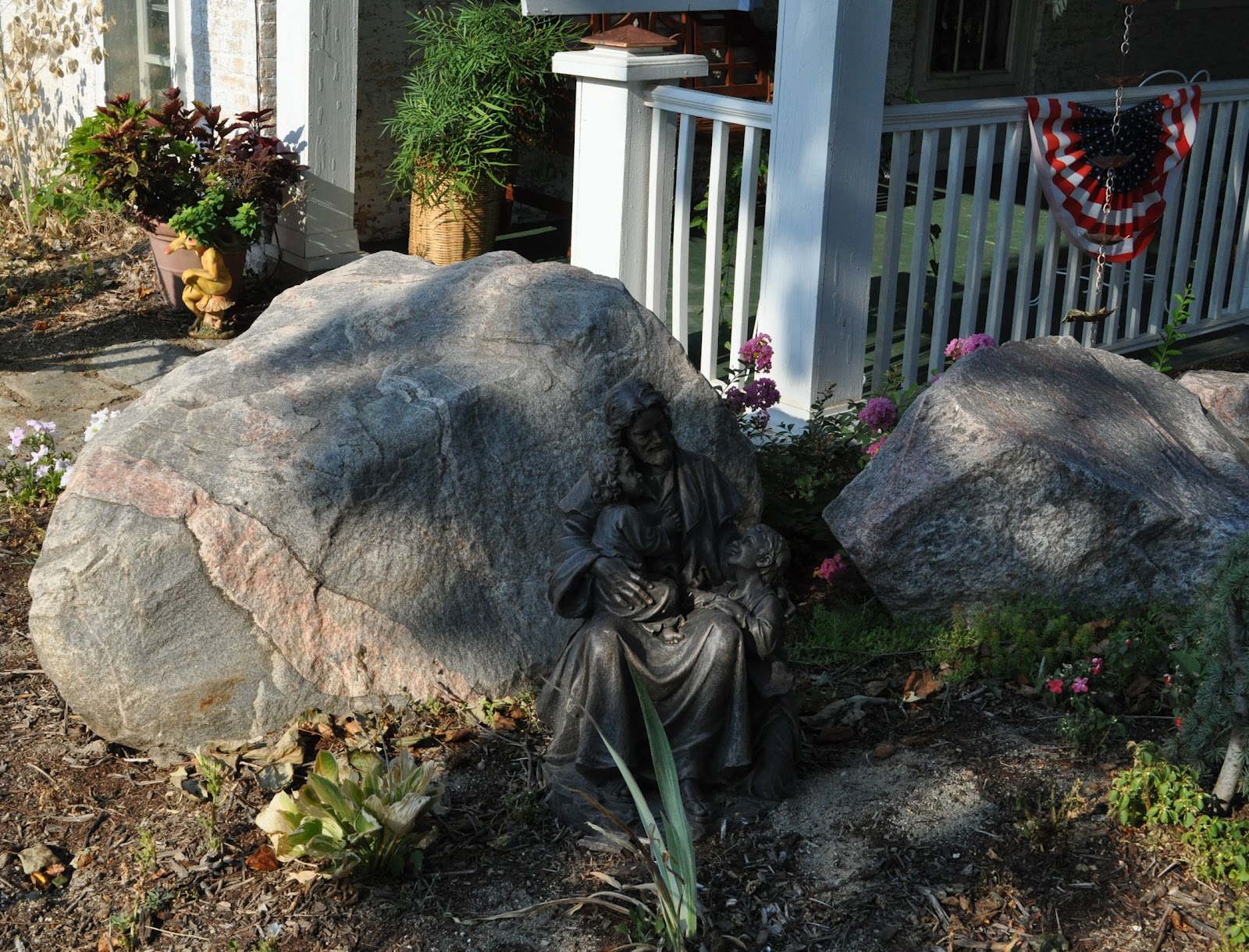
You can't see the daylily breeding area from here.  Daylily breeding is not a pretty sight.  The rows of black plastic weed fabric are lined with unique plants fighting for their short-term life in a nail-biting draught, hoping Bob will favor them with several years of "further evaluation" and possible registration and sale down the line.  What you see as you enter the zone of Bob's life is a beautifully designed tranquility garden featuring a collection of distinctive rocks with companion plants.



Then you walk back into Bob's breeding zone.  The crazy weather this year brought on a bloom season two or three weeks earlier than average.  Bob's daylilies were well past their peak bloom, and yet I saw scores of seedlings testifying to Bob's interest in patterns on the floral face.  I was especially drawn to this one for the huge lavender eye on a clean cream face that curves down and out again as if dancing the Limbo.


This, too, drew my complete attention. The petals curve inward in a suggestion of modesty and shyness, but the complex pattern within suggests that the modesty is concealing a spectacle of colors.  The soul of this one is decidedly "mysterioso."


This next one is outspoken and brash and probably should run for President the next go-round, if only for a week or so.  This is like a belted song on the Broadway stages, and no microphone is necessary, thank you.


You can imagine the summer days of Bob-the-Artist as he weighs the best of these and looks for the excellent plant structure beneath these dazzling and seductive faces.  His garden is chock full of distinct faces.  His cup runneth over.

You've got to have a sense of humor when the weather conspires to punish your garden just before a tour.  We all chuckled at the sign on this fence.


This was one of my favorite stops of the whole convention, and it had the fewest flowers in bloom.  Maybe it's because I was started out like all those seedlings, in a country town where my grandparents got their fresh eggs from the chicken coop.

Sooner or later on a bus tour, the captain blows the whistle and it's time to say goodbye.  So little time....so many faces.


Thursday, July 5, 2012

How Does Your Garden Grow?

When I lived in Vermont (1975 to 1995), everyone we knew grew flowers and vegetables.  The customary pleasantry when seeing a friend was, "How does your garden grow?"  Mine is either in heat shock or in rampant growth, depending on what the plant is.  Some of the hydrangeas have scorched leaves, and one of the river birches is on intensive care.

I'm taking refuge indoors today.  The morning started out near 80 degrees, with enough humidity to make the sweat begin to pour off my head despite my good Tilley hat, and that was not yet 7 am!  So, whether I deserve a day off from weeding, edging, and mulching, I'm taking one.

Kathy's car park garden, so called because it lines the big area where we back out of our two-car garage, has been a thing of beauty and wonder.  Last summer we drowned the six tomato plants we put in the back yard.  This year Kathy put them in the new car park garden.  It's an Italianate planting area, which suits her heritage.  To look at the area, you might think it's a "HomeDepot-ate" area, because the plain blocks from which the wall is built can be bought just about anywhere.  Yet they remind me of building materials that enchanted me on my two visits to Italy, and so I think of this area as our Italian villa, on the shore of "Lago Segretto" (Hidden Lake).


There's our patch of Roma tomatoes.  I took the picture on Monday morning.  Today, Thursday, they are fist-sized.  Two feet to the right is our Basil grove.


The plants look twice as lush today.  We've already cut them back once almost to nothing to make our first batch of pesto (15 bags of two servings each).  On Monday we'll harvest the leaves again for another batch.

Kathy used those simple blocks to make raised beds in the back yard.


We had a pallet of blocks delivered and dropped in the central bed last week.  Then our helper from next door placed the blocks on the brick foundation layer Kathy had measured out.  We're ready now to order a topsoil and compost mix to put into the beds.  They are not very deep, but we think they will suit the purpose.  We built them because in a normal year, that's a wet area that can't be worked or tilled until it's too late to plant a garden.

In keeping with the Italian theme, I grow the daylily "Bella Sera" down there.  The strange springtime weather this year shocked some plants into bizarre behavior.  Bella Sera started to grow in March, and then all the foliage turned brown and it looked dead.  I decided to do nothing and see if it was just regrouping.  Sure enough, in the end of June it started to put up a fresh set of leaves.  It won't bloom this year, but it will recharge itself with sunlight.  I have several other daylilies that experienced the same shock, disappeared, and are growing new foliage now.


Most of our collection of about 800 daylily cultivars put together some kind of bloom for us.  Here is Karol Emmerich's "Secret of Contentment" on Monday morning, looking somewhat frosty from the blast-furnace heat we've been having.


And here is a newcomer to the collection this year, Curt Hanson's "Chew Mail Pouch Tobacco."  This is probably the only time I will photograph it while looking down.  When it establishes it will produce an extradordinarilly tall scape, and I'll look straight ahead, or up a bit, to take its picture.


Thursday, June 21, 2012

Hybridizing Daylilies in the Bliss and Torment of Ignorance

Out in the garden morning after morning, there is the bliss of birdsong and breeze, the pleasure of working a plan based on dreams of what might be.  I have saved a lot of seedlings because they represented "success" in a failure kind of way, know what I mean?

Here's one I love to have in the keeper bed.  I keep hoping that some year I'll lay claim to a full version of success.  I selected it in 2005 from a cross I made probably in 2003.  I wanted to correct the poor opening of MAPLE HUES by crossing it with a consistently fine opener, WYOMING WILDFIRE.  When I first saw WYOMING WILDFIRE in the Salters' catalogue, I knew I wanted to cross it with MAPLE HUES.


The success of correcting an opening problem was offset by a failure to breed a scape with adequate height, branching, and bud count.  My successful opener is to low too offer any garden pleasure except when it's on the outside edge of a border on a slope, so you see it as you walk up the slope and ignore it when you walk down.  

Every year when I remember to do so, I cross this with something better and hope for magic.

Here's another sort of success.  I wanted to try to get something clear pink out of my friend Mike Derrow's PRELUDE TO PANOPLY, so I bred it to Patrick Stamile's TRUE PINK BEAUTY and kept two seedlings for further work.  One of them is darling, but like my success/failure in orange, it nearly hugs the ground in shyness.


I love looking at flowers like this, and all too often in my keeper bed, I have to look way, way down to see them!

Here's another sort of tarnished success.  I forget why I thought it was a good idea to cross Matthew Kaskel's orange CLOCKWORK with Patrick Stamile's yellow STONE BEACON, which is taller.  I imagine I couldn't think of how to use CLOCKWORK and had decided to let it go.  What happened?  I got a plant full of these delightful orange flowers that are smaller than either parent on the short scape of Clockwork.  I like orange in the garden, so I'm using this from time to time in a try for more height and a better scape.


However....my seedling lacks distinction.  It reminds me of Curt Hanson's wonderful polychrome named THE GOLDILOCKS EFFECT.  Curt's daylily is all around better than this and there is no reason on earth why I should waste seedling bed space growing seeds from this one when I have far better chances of success if I breed with Curt's "Goldi."  They may look alike in a photo like this, but one is not at good as the other.  Saving something like this puts me at Square One, which is where I began sixteen years ago.  This is knock-off hybridizing, child's play.  Neil Young's "I Am a Child" should be playing in the background right now.  Saving this is a portrait of my ignorance.  I've got to throw it away and everything else of its ilk and concentrate my attention on things that strike me as different and special.

Here's one I'll keep working with.  I have four or five seedlings that are a clear lavender or orchid lavender.  This one from BELLE OF ASHWOOD X AUGUST WEDDING shows just a hint of a blue eye, which is generally overlooked in the garden because the form and color are at the right height and lend a soothing effect.


This next is from the Big and Tall shop.  While I now recognize the shade of pink in the eye as the genetic stamp of its grandparent, CLARIFICATION, that doesn't detract from the effect of seeing it in the garden.  I hope I like it as well a few years from now when I line it out for its final audition.


And this is one of two kids from BRIDGETON FINESSE X COSMIC ODYSSEY that have an identical pattern but display it in different colors.  This is the darker one.  


The lighter one shows a lavender eye with a neater scalloped edge.


I like seeing the eye broken into segments like that.  Or course I should cross them with each other, but part of my ignorance is just thinking of that NOW!

Another aspect of ignorance is wondering what to do with someone else's plant that appears to present both opportunities and challenges.  For instance, a few weeks ago at our club auction I won a plant that should have gone for three times my bid.  It's RUFFLES HAVE RIPPLES by Ted Petit in Florida.  Sometimes what looks "lavender" or "cream" in Florida suffers a color shift in Missouri.

The first morning it opened, just a month after I planted it, this was the flower.  The rippled eyezone was apparently triggered by a succession of cool nights.  The name of the flower comes from those ripples, and the large size and toothy edge are what makes this one coveted on auctions.


I took the picture before the sun was up over the trees.  Aside from the splotches and wonky opening, the background color seems to have a suggestion of pale khaki in it.  A couple of days later, same time of day, but after some warmer nights, the flower looked like this before the sunlight added red color to everything.


The color problem and opening and blotchiness are all transformed here, but the ripples are hiding.  I feel the weight of ignorance when I consider breeding with this.  I don't know if it's ever possible to clear up the underlying khaki hints.  I consider this plant a mixed success but one that's light years ahead of my keepers.  On its good days I'll allow myself to be swept away and on its bad days I'll dwell on something else.

This one never has a bad day.  It's QUEST FOR ATLANTIS by Jeff Corbett.  I aspire to make a majority of my collection meet this standard.  I want constant reminders of what the best of success looks like.


Saturday, June 9, 2012

Ninety Degrees of Separation

The heat is on this weekend.  This morning as I helped my club sell potted daylilies at a local farmers' market, the thermometer worked its way up toward ninety.  It was ninety-one in St. Peters when I went out to look at the garden after a  two-hour nap at 5 pm.

The heat was dry today, unlike our usual high humidity, and the dryness took a lot out of most of the daylilies.  When you survey the scene at drive time on a hot day, be prepared to wince at what you see.

And yet, many cultivars can take a day like this and still provide garden value when no sane person would be taking a garden stroll!  It's best to wait until the cool of the day for that.  The best flowers will recover much of their beauty as the sun begins to wane and the temperature eases back down.

Here are some of the beauties that still gave pleasure at ninety degrees.  Tied for first place was this gorgeous spider, AZURE WINGS by Patrick Stamile.  Kathy had removed the pollen in the morning to store in the freezer.  She is working out a marvelous system for numbering her daylilies and the pollens she has collected.  This daylily has never had a bad day!


Also tied for first place is Ted Petit's huge melon pastel, THE ANOINTED ONE, which Kathy insisted I go out to see.


When you consider that this is a new plant that arrived in the mail just a few weeks ago, the size and quality of these first flowers speak volumes about the exceptional plant energy of this cultivar.

Running a close second was the phenomenal dark red, BRITISH STERLING by David Kirchhoff.  One of the hardest things to achieve in breeding dark flowers is resistance to full, hot sun.  This flower barely showed the effects of the day and therefore gets many stars for garden value.


Right up there in the ratings was Tim Bell's A FEW GOOD MEN.  It looks just like this in the morning.  The only reason I don't rate it as tied for number one is the somewhat muddy background color of the flower and the way one of the petals has curved over, perhaps in self-protection.  The lack of color clarity in the background color makes me assign a lower garden value to it.


Another highly-valued flower in my collection is this gem by Mort Morss, KARELIA, which I can't imagine ever taking out of my collection.


The next few are also solid performers on a day like this and are in the mid rank of second place only because of a bit of fading.  Here is RAZZLE DAZZLE CANDY by Patrick Stamile, which arrived here in late March and is blooming on it's second set of scapes, the first having been clipped for shipping.


Here is Joel Polston's DRAGON EMPRESS.  This is a flower that definitely needs heat in order to open.  The previous three or four blossoms on this plant were unable to open after the cool nights we had last week, but today's blossom shows me why I was so eager to add this to the collection.


That flower starts the day with such a concentration of color that even a day like today can't fade it enough to make it an also-ran.  This is my kind of daylily!

Wednesday, June 6, 2012

The Band Must Play On

This daylily, THE BAND PLAYED ON by Patrick Stamile, is a favorite of mine and a sentimental marker of one of the best periods of my former marriage of almost thirty-two years.  It was in mid-June in 2008 when this flower first bloomed in my garden.  The colors were just like this.


I brought the blossom home to San and placed it on her dresser where she could see it from her bed.  It was there in the small shrine she had created with pictures of her mother and father when she was a small child and they were still a couple.  San's life energy was ebbing away much like a tide recedes from an ocean beach. 

We didn't expect her dying time to be one of our best times, but that's the way things turned out.  Our teamwork was perfect.  Since she knew there wasn't a future any more, she was able to let go and leave the future to me.  I was able to devote myself to her needs.  She trusted me.

She entered a tranquil zone and enjoyed the messages from her friends and students, who knew her time was down to a few days.  She slept more often, and one afternoon she lapsed into the final sleep.  I became "The Band" who had to play on, and so I played on, uplifted by the memory of what we had just lived.  Every spring I recall what was going on with us in 2008.

Every autumn I recall the miracle that was the correspondence that grew up suddenly between Kathy Wofford and me, and the intense courtship of words and thoughts.  San encouraged me to marry again, as I knew I would want to, and Kathy is the blessing I earned with a long marriage to San.

Kathy is a hybridizer, too.  This morning we both gasped at the glorious color of Curt Hanson's FEEL MY HEARTBEAT.  There are times when you look at a flower's size, form, and color and you can imagine the thrill Curt Hanson must have felt when he first laid eyes on this as a seedling.


Here's one I had to buy for Kathy this spring.  She has a cat named Ginger who rests on her stomach and stares at her when we watch movies.  This is Rich Howard's PAWPRINTS ON MY HEART.


Kathy loves to study the various daylilies in our big collection.  This one in "my" block of breeders is going to be shared!  She loves lavender and loves unruffled faces, so Steve Moldovan's WIZARD'S WAND is just the thing for her.


Me, I like fizz and pop on the face of a flower.  Here's Patrick Stamile's RAZZLE DAZZLE CANDY this morning.  It's hard not to stop and stare when this is open.


"How was I to know there was a party goin' on?"  That song line came to mind just now.  This has "Bobby Darin attitude."  One with more restraint in terms of fizz is Luddy Lambertson's BLUE HIPPO, which is not big enough here to deserve the name.  I think of it as a "Blue Sweet Thing."


My bet is that next year if I leave it alone it will gain hippo status. 

It's funny how people name things.  Bonnie and Stan Holley must know a runner because they have named flowers HEART AT REST and RANDALL THE RUNNER, pictured here.  I imagine Randall makes a BIG impression to have such a bold flower as his namesake!


Unrelated to running, but concerned with the journey of life, is this charming flower by Karol Emmerich, FINISH THE RACE. It's not up to speed or size yet because I moved it a month ago.  Even so, the energy of the center is what this flower is about, and what my memory of 2008 is about.


Monday, June 4, 2012

Daylily Color, Form, and Pattern

There is some kind of malaise in the daylily collection here and in many locations across the country.  Most of us think this is related to an unusually early onset of spring, with unseasonably warm temperatures triggering a wake-up that would have best been delayed another three weeks.

The plants were then subjected to wild swings in temperature including a frost or two in mid-April.  That's our usual final frost, but considering that the daylilies began to grow three weeks ahead of the norm, that last frost happened in the "virtual May" of the garden.  That is evidently harmful.

Many plants began to show yellowing of leaves.  Scapes emerged only to yellow and wither.  Or flowers bloomed and set seeds and then the seed pods withered and the scapes died.  The whole garden now resembles a sick bay, but with bloom.

One is tempted to put one's mind into arrest and try to live in the imagined future of 2013.  I catch myself doing that.  But the truth is, the future does not exist and neither does the past.  Regardless of what the calendar says or what time your wristwatch or iPhone says it is, there is only one time and only one place: now and here.  We have a choice of living in our imagined past or future or participating in the moment we find ourselves in.  If the garden is a sick ward, let's see the patients as real presences in the here and now and forget about what they might look like next year.  They are whatever they are this year.  Let's listen to the singing of birds, the rustling of leaves, the sound of workmen on the roof next door, the splash of ducks landing on Hidden Lake.

Here is a daylily that bloomed for the first time here this week, and I liked it a lot better than the picture I found on the internet.  There is something vivacious about Emily Olson's BEAUFORT SLIM PITKIN.  The flower has attitude.

I like the clear red color and the red veins showing on the lighter red edges.  The cream piping adds a sense of "finish" to an obviously carefree presence.

Now here's a different sort of color plan.  Look at the fading of the dark purple of Steve Moldovan's BRAVO CARUSO near the edges and then look at the unique webbing inside what might have been a plain blue center.  This is a daylily to play with for pattern effects!


On a whole 'nother scale of pattern is the very fancy CONCERT MUSIC by my friend, Phil Reilly.  I suppose the reason I have never seen it look this good in the past two seasons is that the plant was new in 2010 and then it was moved to a temporary location.  It was moved again one year ago to the spot it occupies now.  The plant is growing in full sun for the first time and it is more mature.


Kathy is having a ball with the collection of spiders and unusual forms I bought for her use last year.  Suddenly I am living with a real hybridizer.  Here is Jamie Gossard's ELECTRIC LIZARD the other day.

We both enjoy the strong and bold purple eye on that pink background, and we love the curvature of the floral segments.  The confusion in the picture is caused by a second blossom colliding with the one I photographed.  This is a serious flaw.  We'll have to grow this plant a few more seasons to judge whether the flaw is occasional or typical.

Bob Selman's MARILYN LEE BOCK is a rosy bi-tone with a beautiful scape.  We both marked this as special.  I like the pale silvery watermark around the green throat.


We had several unseasonably cool nights this week, which revealed a trait we have only a few chances to observe here, "cool morning openers."  Some of the flowers never opened at all yesterday, but this hot one, KISSED BY MAGIC by my friend, Paul Aucoin, was easily the best example of a CMO.


One of Kathy's spiders, PRETZEL POWER by Patrick Stamile, has been seemingly "kicking up its heels" this week.  It made us feel happy all over to imagine the joy of a pose like this on a human being.


Some daylilies resemble exotic sea creatures.  Here is Jeff Salter's FANTASTIC FRINGE yesterday morning, begging me to share its pollen.


And then there is the elusive, ephemeral personality of Gayle Story's HEAVEN'S MIRAGE.


This is one of the many children of Larry Grace's DESTINED TO SEE.  We grow DESTINED TO SEE and many of the blue-eyed offspring from it.  This next one, though, is a knockout pattern that expresses the genetic conflict of combining dissimilar eye patterns at the grandparent level.  It is Karol Emmerich's HANDWRITING ON THE WALL.


I'm enjoying several "pattern daylilies" that are blooming for the first time here this week, and one that has settled in after a year in the garden.  Patrick Stamile's WINTER RAINBOW appeared to be a goner when I checked the garden in March.  Then a sign of life emerged, and then a full-scale plant, and then some signs of increase.  I always experience a sense of the miraculous when this happens.  Here is WINTER RAINBOW this morning.

 
This play of quasi-blue, purple, and silvery lavender is thrilling, so much so that I forgive and overlook the flawed shape of the sepals.  We do not live in an ideal world.  I can take delight in the here and now of this flower.  I can marvel at the hint of blue on the anthers.  Amazing!

Here's a new one that arrived in April, Patrick's RAZZLE DAZZLE CANDY.


I am a pushover for these black edges outlined in beads of silver.  If this daylily looks this good soon after arrival in the mail from Florida, I can't help imagining the pleasure it will give me next year.  But that is assuming the plant is winter-hardy here.  I'll have to enjoy it right now, as if it may be an annual, and hope for the best.

Also a pleasure right now, even though I have to crouch down to view the flowers on a 5" scape, is a new arrival just a few weeks ago, Ted Petit's ROYAL CYPHER.  I sure hope it grows a scape of normal height next year and that the flower is much larger.  But I am soaking it up now, because now is all there is.


I anchor my collection with a good number of varieties that originated decades ago and held their place in people's affections.  I'll close with an image I took this morning of a daylily I wanted for several years before I finally sprang for it.  It has been one of the most beloved daylilies of the past twenty years.  In color class, it is "pink."  Yet when I look at the blossom from the side, I perceive a thin veil of blue, perhaps a layer of lavender only one cell deep.  It gives this perfectly-formed flower an additional aura.  I mean, of course, Charles Pierce's BARBARA MITCHELL.