Tuesday, November 19, 2013

Breaking Up Is Hard To Do

This is a Western tale, the tale of "Coffin Rock," where bad things were turned to good from high noon to sundown.  There was no gunplay, or none I'll fess up to.

It all began a week ago, when I resolved to finish my season of digging in the daylily beds that would become Kathy's seedling area next season.  As I cleared out my own seedlings, I also tossed aside five- to twenty-pound pieces of "historic" highway rubble from the construction of Hwy 94 years ago.  The previous owner had called in for "fill" to correct the lowest part of the back yard.  He forgot to say "clean fill," so what was delivered became the curse and bane of the next owners' gardening hopes.

Along about five feet down the line of plants I was digging out, my spade struck something harder than a chunk of asphalt.  An hour's digging around the obstruction revealed a rough chunk of concrete the size of a coffin.

Named 'er Coffin Rock.  Here she is this morning just as Steve and Tim, our "resident contractors" arrived.


They knew what they would be up against, so in addition to Steve's tractor, they brought a jack hammer.  Here's Tim reducing coffin rock to a couple of pieces.


Each piece was too heavy to heft out, so the backhoe came into play.


Then Steve set about gouging out more stones and rubble, some the size of baby elephants.


He was relieved when I told him he only had to clear the area to a depth of 12 inches, because the rubble field went way, way deeper than that.  You can see the pile of "artifacts" from the Hidden Lake Rubble Museum on the left side of the picture.


I suggested that if they found any skeletal remains in the concrete, they treat them discretely, using the lake as a reference area.

Things got a bit less bulky, and Steve switched to the front-end gouger or whatever you call it.


Work proceeded at a brisk pace.  There was not much moisture in the top twelve inches of the dirt.


I was relieved that they were able to get this ground in shape.  Hand-spading would have taken time I don't have at this point in the cooling season.

As Tim rough-smoothed the dirt, Steve went up for bucketloads of leaf compost sitting in a great pile in our driveway.


I don't know how many wheelbarrow trips this area would have required, but I think it took six visits of the tractor.


I could smell the "tobacconist shop" aroma of the hot compost up on the deck.


Things timed out pretty well.  Just past sundown, about 4:45, Steve dropped the last bucket load and the two men tapped the metal edging back into place and left for the day.


The layer of mulch is one to three inches deep.  It will be good earthworm food.  In the spring I'll till it into a strip of ground where Kathy will plant her seedling crop from this year's hybridizing.  Good night, Garden bed.  Good night, Coffin Rock.  I hope I never see the likes of you again.

Monday, June 10, 2013

Companionable Plants

In the year 2000 I developed an irregular-shaped bed of daylilies at The Green Center in University City, Missouri.  I had promised to mix other perennials in with the daylilies, and in fulfillment of that promise I bought a Crimson Pygmy barberry bush of small size and planted it as a focal point at the rounded end of the bed.  You could call the shape of this part of the bed a "finger" or some other long body part.  I imagined the barberry bush as a background for viewing the daylilies planted all around it.  One of the most effective combinations involved a seedling of mine that I later named PEPPERMINT WIND.


In this picture, the barberry bush makes a "jeweled" background for the daylily blossom.  The picture would be blah without it.

In our back yard I made sure to design a circular bed with a Crimson Pygmy barberry in the center of it.  The circle is ten feet across, so there is room for a ring of daylilies at the edge.  I'm using white, pink, rose, and lavender colors in the daylilies.

At this time of year, the hardy geraniums named Rozanne are growing lush and nuzzling up against the barberry, making a most companionable impression on my imagination this morning.


Outside our garage we have mixed perennial beds along the concrete.  At one location, I planted a group of lavender plants -- Hidcote and Munstead.  In March this year I pruned them back, so when they began to grow in spring they grew lush and bushy.  This week they're coming into full bloom along with a raspberry colored Yarrow plant snuggled in close.  I love the look of this snuggling!


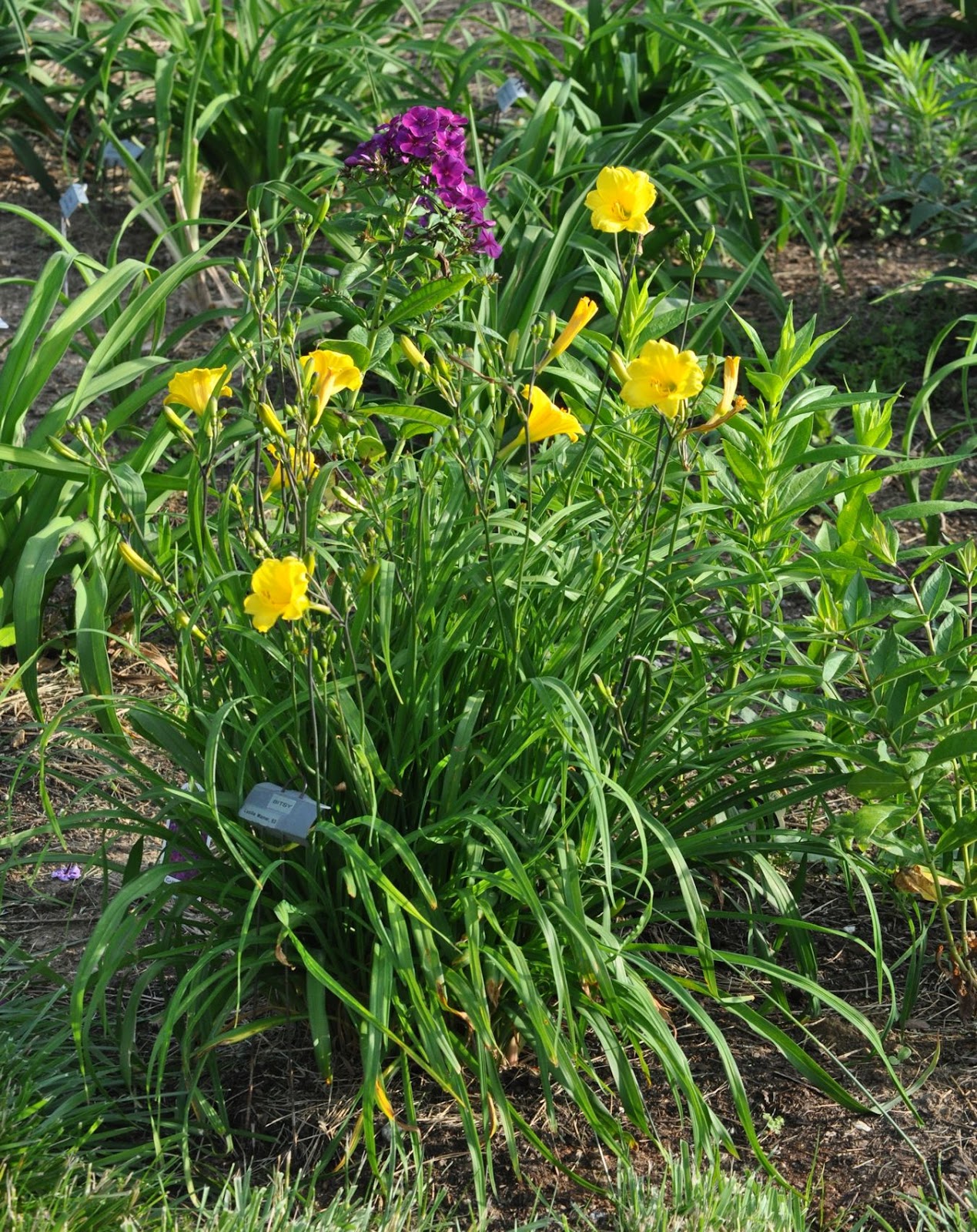
I find it hard to put daylilies into companion relationships, though I continue to try various ideas. This is the early daylily Bitsy with an intense garden phlox next to it.  This isn't going to work until the phlox group is thick.  At the moment, there's no backdrop, just a random blurt of color.


 The real success with companionable garden designs are in our two berms, which Kathy manages.  She's working out a scheme to provide continuous color.  A week ago, the pinks were providing the main accent.  There's also the interest of three redbud trees, three Fire Chief arbor vitae bushes, and masses of Russion Sage growing larger day by day.


We also have companionable animals in our lives here.  There are at least two birds' nests attached to the house, humming birds at our feeders outside the kitchen window, and a trio of ducks that our neighbor gave his wife a year ago as an Easter present.  They have adopted or appropriated our back yard as a second home, and they especially like the companionship of the scant shade under one of our smoke trees.


Sunday, May 26, 2013

Color at the End of May

I took a few minutes today, just a few, to enjoy the shapes and colors in the garden.  This salutary practice is contrary to the doctrine of "the overwhelmed landscaper," a class of people who tend to bite off more than they can chew and then gripe about it with their mouths full.  Epic yardwork projects are a way of life for the overwhelmed gardener.  Since we're not camping out on a ten-year siege of Troy, and since no bard is available to sing of our anger, feasting, or hideous death by pitiless bronze, we make plans we have little hope of seeing through and then, quite late, and incompletely, see them through on a landscape.

My back aches.

We have designed our gardens to delight us with form and color before the main season of the daylilies, which occupy most of the garden space on this acre and a half.  Just today I noted the beginning of daylily season with the opening of the charming miniature flower named Bitsy.  It was a Father's Day present to me from my late wife back in 1992.  We lived in Hyde Park, Vermont then, and our favorite place to discover and buy plants was the Cady's Falls Nursery in the tiny hamlet adjoining Hyde Park village.  That's where San bought Bitsy for me.  Don Avery was reluctant to carry it because its foliage coming out of winter looked a little ratty.  Ratty looking daylilies don't sell until they grow better leaves. 

So I've grown Bitsy for twenty years.  I hope for twenty more.


Bitsy is sited on the near corner of one of the beds we see down below us while sitting on the deck or looking out the dining room slider as we make breakfast, lunch, or dinner.  It's a lucky break that the garden phlox I planted next to Bitsy also came into bloom this week.

Typical of the driveway of the overwhelmed landscaper is an array of potted plants not yet planted.  The zinnias and yarrows below have been on the driveway for a full week now.


The name of that zinnia is "Inca." 

On the other side of the driveway there are small zinnias to accompany several other yarrows, and they are actually planted!


This past week marked the beginning of our annual poppy season.  Two years ago on May 27, my Wichita friend, Linda Farris posted to the daylily Robin about her annual poppies.  Here is what she said:

"I decided to stay home and play in my own yard this weekend.  Here at Fieldstone Cottage there is always another bed to weed or more plants to set in.  Still blooming strongly are magnificent double pink and red poppies which form huge swaths of coral pink or intense red in whatever bed they rest. These pinks were heritage-bred poppy seed from the Ukraine, brought to this country with Russian Mennonite immigrants some 150 years ago.

"My original seeds years ago were a gift from a Mennonite descendant and thrown out over a December snow-covered flower bed.  Imagine my total surprise when they sprouted in February, grew to enormous mass in April, and bloomed with vigor in May and June. They are a jaw-dropping sight.

"My red poppies were a gift from above.  I'm guessing that a single seed must have come in on a load of compost from our community recycle center, as one year a single red poppy plant appeared in a pink poppy patch that was mulched the previous fall with community compost.  The robust red double poppy plant made tremendous seeds, which I saved and cast out the following winter in its own huge bed.  As they are self seeding, I now have a 30 x 175 foot bed filled every year with these red beauties.

"My pink bed covers a 16 x 40 foot area in front of our
home."

Here is the pink poppy we started last year from seeds Linda sent us.  This one must have germinated last fall, as all the others are much shorter.


The Siberian Irises also bloom with the peonies at the end of may.  This one is Light of Heaven.


Amber White is a Siberian iris we received as a gift from the renowned daylily hybridizer, Mike Huben, when we spoke to the New England Daylily Society in October of 2011.


The smoke bushes at the lakeside are at their most colorful in late May, just as the knockout roses come into bloom.


To the left of that scene, a Crimson Pygmy Barberry bush provides a reddish purple accent in a circular bed of daylily foliage and emerging poppies.


What is overwhelming the landscaper, who feels five weeks behind right now, is the epic project of moving the selected daylily seedlings into a new bed on less sloped ground so that he can rework the terrible soil in the old bed and plant his new daylily seedlings there.  He (me) is digging a hole for each transplant and is mixing two shovelfuls of compost into the dirt of each hole.  The process of transplant entails inspecting each plant for its habit of growth and dividing it if there are a lot of fans growing tightly together.  This is the smallest of three sections of the new bed, and I mulched it this morning.


An important feature of late May for a daylily collector in St. Peters is the coming into bloom of the daylilies that arrived from sellers in the deep south.  I bought over two hundred new daylilies, a record for me and the main reason I'm overwhelmed.  Today, my favorite of the southern bloomers is Cat's Eye by the Mississippi hybridizer, James Townsend.


I took this picture at noon, but the flower was open perfectly after a cool night when I went out at eight this morning.  I love everything about this face!  Just thinking of it makes me stop whining!

Tuesday, May 14, 2013

Promise

As the cool spring gives way to the warm spring, we have had weeks of enjoyment from flowering plants that in some years only last for days.  I've been preoccupied with planting hundreds of daylilies that have been arriving in the mail and going straight into buckets of water to wait their turn.

Yesterday, I took some time in the afternoon just to enjoy the plants in their spring personalities.  Here is a simple pleasure: a pot of chives.  We seldom think to use these herbs.  They have grown in this pot for years, and in the spring they flower.


Just below that pot is a thriving plant of Yarrow.  We grow many types of Yarrow around here.  They are plants for an arid climate, yet they do well here.


These plantings are in narrow beds that line our "car park" area outside the garage.  To the left of this Yarrow is a native Baptisia with yellow flowers that will open in a few days.


You can make out the carpet of herb "somethingorother" at the base of the Baptisia.  Kathy knows these herbs, tends them, encourages them, and tells me their names.  But I'm not good with names of any kind except for daylilies, family members, and pieces of music.

A steep slope leads from the car park down to the back yard.  Thanks to a previous owner's planting of three ash trees, we have some shade on that slope, where Kathy has made a garden of shade plants.  This is Meadow Rue.  It grows tall, provides clusters of fuzzy purple flowers, and delicate leaves to balance the heaver look of all the hostas in the area.  Kathy found four Meadow Rue plants last summer for this bed.


The main interest of this garden is the interplay of hostas, heucheras, astilbes, and ferns, with a border of lariope along the top.


"Caramel" heuchera brings so many shades of color to a garden that you wonder how anything else will attract attention.  And yet, each variety we grow has a unique contribution.  Look at "Snow Angel" below and notice that it's in flower before any of the others.


"Sonic Smash" contrasts "Snow Angel" with a dark pattern on its leaves.


And the native variety below grows and grows and grows to dwarf them all!


The hostas in this bed have a great deal of sentimental associations for me.  Below, a variety of "Aureomarginata" was given to me by my late friend and daylily mentor, Oscie Whatley, as a housewarming present in 1997.


And this plant of "Hadspen Blue," which formed a majestic honor guard along our front garden in University City, made the move to St. Peters.  I haven't seen this variety lately in the nurseries.  It must be out of fashion.  But is perfection ever out of fashion?


Easily the best feature in this garden is the gardener herself, my Keb.


In the back yard, amidst a vast collection of daylilies, we have an iris collection, a peony collection, and mounds of "Becky" shasta daisies, various phlox and coreopsis plants, and three smoke trees at the corner of the property.


I favor the bright lime green colors in contrast with the dark plum, a color which I've used at the center of a circular bed of pink, lavender, and white daylilies nearby.  The accent plant is a "Crimson Pygmy" barberry.


Another circular bed in that area contains a ring of orange daylilies with a "Golden Mound" spirea in the center.


The peonies and irises are just coming into bloom.  This is "Hawaiian Coral" peony next to "Blue Flirt" iris.  The geranium in the background is "Max Frei."


We don't consider the Canada Geese to be "pets" here, but the two who seem to have made themselves feel at home near our dock are bidding to be called "family."


Saturday, April 20, 2013

To-do List, Revisited

This was the scene from our deck a week ago, just after I finished the epic weeding project that was to usher in a "big dig" of plants going to Lily Auction winners.


Alas, only four plants made it into the mail on Monday and then we were beset by rain, hard rain, driving rain, all sorts of rain, vertical, horizontal, leaky, indoorbucketinducing rain, and the entire property became a scene of squish.

This is a view of my front lawn, known as "Swamplandia!" now.  All it lacks is a heard of water buffalo.


It is marshland all the way to the dark green "fescue garden" we put in last fall.  There's no way to deal with this lowland except love it for what it is and get on with what needs to be done.


Every day's mail brings more new daylilies, and they are parked in buckets of water until I complete the digging and shipping for each week.  This weekend I must do last weekend's work.  All gardeners and farmers know this story of the ever-growing to-do list.

Just to the right of this scene as I walk out of the garage is the last untended section of car-park garden.


Kathy planted a beautiful collection of sedums there, and last year's stalks need to be cleaned out.


A blue spruce bush and a golden variety of juniper (I think) both suffered greatly last summer.  I plan to trim the dead wood away and shape what emerges alive.  In the case of the spruce, I know I'll debate whether to toss it and try another, or something else.


I love these lime-colored barberry bushes that emphasize vertical growth.


We made this berm two years ago to block the flow of water from higher parts of the neighborhood and channel it toward the drainage swale rather than across our lineout beds.  We are both enamored of creeping phlox. Its peak bloom follows the weeping cherry tree.

The Kousa dogwoods on this berm are supposed to do well in full sun.  I'm worried, though, about their exposure to "full wind."  I was heartened to see we'd saved them by using a soaker hose last summer.  Their leaves are just starting to emerge.


Water control is an issue on the other side of the front lawn, too.  The small drainage ditches on the other side of the road are not up to the job of catching all the runoff when we have a hard rain, so a shallow wave crosses the street and flows over the two beds of breeding daylilies.


This is the evidence of flowing water across a path in the bed.  On the lower right of the picture, the daylily JOHN GALT has had its roots exposed.


There are four or five plants with exposed roots at various locations in this bed.  I have bags of topsoil on hand from Home Depot and will use it to build up the soil level in the washed-out areas.  But then I have to work out a method to direct the flow of storm water, which probably will entail putting in metal garden edging so that the path becomes the water channel during rain.


This is a new bed for selected seedlings, which are currently growing in a rectangular bed slightly downhill from the new location.  I had thought that by this time I would have moved several dozen plants into this bed to make room for new seedlings.


These are the seedlings we want to plant.  They haven't matured enough to plant, which is good, because the ground is too soggy to till.  Preparing the ground is another to-do item.

There is no use in fretting and stewing when the temperature or watery conditions force you to remain indoors.  The thing to do is rest up, because you know you're going all-out when the window of opportunity opens wide.