Showing posts with label daylily. Show all posts

Sunday, June 8, 2014

Personalities of Plants

Many of the plants here have personalities.  Take, for instance this colonnade of the ornamental grass, Karl Foerster.


Sometimes I think of these as an honor guard.  Other times they are a chorus line of dancers with big plumes waving in the breeze.  We planted them along this series of paths that provide an easy way to walk though large beds of daylilies, with a wheelbarrow, a watering hose, or a friend.  

From this vantage point, you can see that the paths form a diagonal line with respect to the curves that define the edges of the beds.  Hidden Lake Drive is not visible in this picture.  It's on a horizontal line about 2/3 of the way up the image.  People walking from right to left on Hidden Lake Drive would take notice of this colonnade cutting across the opposed curves of the flower beds and converging on a berm that defines the corner of our front lawn.

Kathy placed these bright coneflowers against the block wall that was three feet farther back when we moved in.  The planting area on this side of the wall was too big.  The planting area on the other side was three inches!  Kathy asked our "resident contractor," Steve Brandt, to move the wall so that we could plant on both sides.  The wall reminds me of many walls I saw in two trips to Italy some years ago, so the wall has "personality" that I invest in it.

A little farther up the wall, there's a zigzag to make the wall meet the column supporting a white globe "night light."  I wanted some lavender plants, and Kathy dressed one of them up with this bright raspberry Yarrow, backed by the feathery foliage and small cream pink flowers of a Potentilla bush.

Another effect I like very much is the juxtaposition of sedum plants (Kathy has a big collection) with plants of contrasting texture.  In the upper left, a native Baptisia plant with yellow flowers in May.  Garden phlox on the upper right.  Yarrows here and there.  It's the sedums, though, that speak to me of Kathy's nature.  I am fascinated with all of her collections; her buttons, her Shawnee china, her full set of Perry Mason books by Erle Sanley Gardner.

There are several personalities in the circular bed above.  I planned this around the "patient presence" of a Crimson Pygmy Barberry plant.  I first bought one of these to anchor the end of a long bed of daylilies at The Green Center in University City.  I loved the effect of pink or rose daylilies with the Barberry as a background presence.

Here I think the bed is crowded with too many nice ideas.  I love the coral pink annual poppies.  I also love the blue violet Geranium, Rozanne, but it grows pretty big for the space it's in, and I love the blue flowers of Plumbago, which is not quite visible in this picture and is not yet in bloom.  The big clump of the daylily Barbara Mitchell in the foreground is going to overpower the bed in another two weeks when it's in bloom, so I have to think about reducing the bulk of that plant.

Here is a daylily that carries a twenty year memory for me, BITSY.

This plant was a Father's Day gift from my late wife, San, back in 1993 when we lived in Hyde Park, Vermont and bought many of our garden plants from Don and Lela Avery at the nearby Cady's Falls Nursery.  Bitsy starts the daylily season for us and it comes back with another round of bloom in the fall, continuing until a killing frost in November.  

In another bed in the back yard is a daylily named RIVER WIND by my California friend, Bonnie Holley.  What a personality this plant has!

This calls to mind an extravagant daylily purchase I made fourteen years ago, when Matthew Kaskel introduced his TAR AND FEATHER and said that if anyone owned just one of his daylilies, that should be the one.  I bought it, and I was wowed by the bold color and pattern.  Tar and Feather is the grandparent of Bonnie's RIVER WIND.  I see the vibrant color personality of it, but this plant is not a knock-off.  It's a step along the path of discovery that is hybridizing.

Our vegetable beds have been planted for ornamental impact this year.  In one of them we've got four artichoke plants that seem to double in size every couple of weeks.  With any luck we will be harvesting artichokes in October.  Getting there with such a statuesque plant is going to be fun!

I have enough frozen pesto to last four or five years at the rate we use it, so there is no reason to grow Basil plants except for the look of them and the scent of their leaves.  Believe me, when the San Marzano tomatoes are eating size, they will be served with fresh leaves of green or purple Basil.  I have four plants of dill to the left of the green Basil.  That's for salmon dinners or just for the fun of having a self-seeding dill forest close at hand.

Beyond the Basil bed is a feeding area for bunnies or ducks, I don't know which.  I planted the whole bed in Swiss Chard.  Some of the plants have been nibbled to ground level, while others are beginning to look too big for nibbles.  I do hope some thrive long enough to provide me with ingredients for the saute pan.

To me, these associations with memory and with human qualities are the essence of gardening.  My garden is a collection of emotional triggers.  My life is in these plantings, hundreds of stories too involved to tell, hundreds of moments, a kaleidoscope of prayer.

Monday, June 10, 2013

Companionable Plants

In the year 2000 I developed an irregular-shaped bed of daylilies at The Green Center in University City, Missouri.  I had promised to mix other perennials in with the daylilies, and in fulfillment of that promise I bought a Crimson Pygmy barberry bush of small size and planted it as a focal point at the rounded end of the bed.  You could call the shape of this part of the bed a "finger" or some other long body part.  I imagined the barberry bush as a background for viewing the daylilies planted all around it.  One of the most effective combinations involved a seedling of mine that I later named PEPPERMINT WIND.


In this picture, the barberry bush makes a "jeweled" background for the daylily blossom.  The picture would be blah without it.

In our back yard I made sure to design a circular bed with a Crimson Pygmy barberry in the center of it.  The circle is ten feet across, so there is room for a ring of daylilies at the edge.  I'm using white, pink, rose, and lavender colors in the daylilies.

At this time of year, the hardy geraniums named Rozanne are growing lush and nuzzling up against the barberry, making a most companionable impression on my imagination this morning.


Outside our garage we have mixed perennial beds along the concrete.  At one location, I planted a group of lavender plants -- Hidcote and Munstead.  In March this year I pruned them back, so when they began to grow in spring they grew lush and bushy.  This week they're coming into full bloom along with a raspberry colored Yarrow plant snuggled in close.  I love the look of this snuggling!


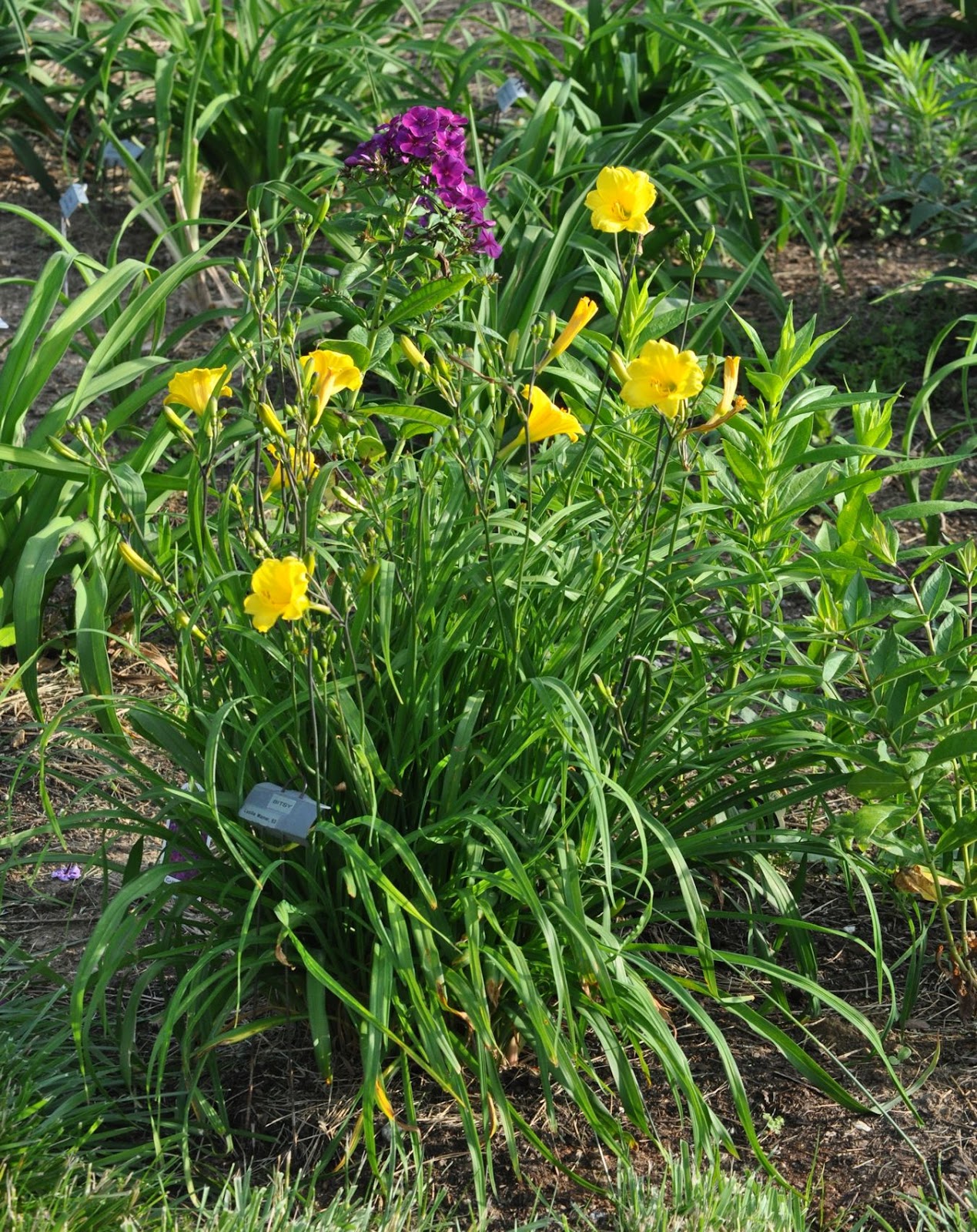
I find it hard to put daylilies into companion relationships, though I continue to try various ideas. This is the early daylily Bitsy with an intense garden phlox next to it.  This isn't going to work until the phlox group is thick.  At the moment, there's no backdrop, just a random blurt of color.


 The real success with companionable garden designs are in our two berms, which Kathy manages.  She's working out a scheme to provide continuous color.  A week ago, the pinks were providing the main accent.  There's also the interest of three redbud trees, three Fire Chief arbor vitae bushes, and masses of Russion Sage growing larger day by day.


We also have companionable animals in our lives here.  There are at least two birds' nests attached to the house, humming birds at our feeders outside the kitchen window, and a trio of ducks that our neighbor gave his wife a year ago as an Easter present.  They have adopted or appropriated our back yard as a second home, and they especially like the companionship of the scant shade under one of our smoke trees.


Thursday, July 26, 2012

Miracles of Water


Blooming beautifully in my garden today is Larry Grace's ANGELS GATHER AROUND.  This cultivar miraculously was internally timed to be unaffected by the shocks of a long, early spring with a hard freeze chaser in mid-April.

Angels have surely gathered around some of our new trees and shrubs, and they are all named "Treegator Junior."  We saw the "senior" style of Treegator around trees in Ohio two weeks ago during the AHS National Convention.  Didn't know the name of them, but looked up various watering devices in the online catalog of Hummert International and found them.


On Monday of last week I drove to Hummert's and bought two packs of ten at about $158 per pack.  If you buy them individually on Amazon, they run over $21 apiece.  The Junior version holds 15 gallons of water and releases it through two small valves on the under side over a period of five or six hours.  You fill each one with a garden hose.  Kathy set them around twenty shrubs that were in danger of being grown this year as "annuals," and she worked out a system to fill all of them within an hour.  That is quite a feat of planning.

All the green you see on Weigela "Wine and Roses" appeared on this shrub in the past few days, as did the flowers.  All the green on the Feathergill below appeared in the past few days.


This Tiger Eye Sumac has not looked this good since I planted it one sweaty day at the end of March.


Most in need of abundant water are our new River Birches.  Look at how the grass near the Treegators responded to all that water.


The surrounding front lawn as been baked hard.


After any normal rain, this cracked area is the bottom of a puddle.  The ground in front drains very poorly, and the low spots look like I should be raising water buffalo after a fall storm.

This greener part of the front lawn benefits from my sprinkler, which has been watering the daylily beds with regularity.  This morning in sub-90 temperatures I finished weeding, edging, and mulching this bed with a three-inch layer of leaf mold and a sprinkling of Preen to keep new weeds to a minimum.  I'd never used Preen before this year, and I don't imagine I'll ever garden without it, now that I've seen what a difference it makes.


Wednesday, July 18, 2012

Majestic Struggle With Draught

Last Thursday morning following a sublime visit to Bob Faulkner's garden, our bus took us to Jeff and Karen Pansing's Majestic Gardens.  The Pansings live on a "century farm," six generations in one place, and it's a beautiful place to live and raise a family and grow pumpkins and mums and daylilies.  Here is one of their pictures of the huge daylily plantation in full bloom in an average year.


Back almost twenty years ago, when I was first ordering daylily catalogs and building my garden, the Majestic Farms catalog was one that I pondered and memorized.  I knew this was a big operation, so the chance to see a farm that helped form my consciousness of daylilies loomed large in my imagination.

The bus pulled into their property, Jeff came aboard to welcome us, and we heard about his three irrigation wells and fifty thousand gallons of water per day not being any match for the draught.  I looked outside and saw his pile of pots for the mum trade.  It's hard to imagine the hours of potting that go into making a business of mums.


We walked just a little ways to the left of this scene and entered a tranquil yard that looked out onto the daylily fields.


As I snapped this picture I could hear the goats in their pen.  I turned to look at them again and saw my friend, the hybridizer Margo Reed, saying hello.  I include this picture of her with her permission.


Animals or statues of animals made for a lot of small delights at this convention.  To the right of this scene is the door into the Pansing daylily greenhouse.  I looked in there and saw a concentration of seed pods such as I've never begun to see in my own garden.


Jeff said it had been a real struggle to keep the temperature down to a safe level.  Fortunately for us tourists, this was not a scorching day.  The shade of the yard was calming.  The unrelenting sun awaited anyone who walked the rows of the daylily garden.  But that's why we came here, so walk we did.

The peak of bloom season was past, that was clear, and the water had been rationed to keep the nearest beds, the ones with seedling crops, watered adequately.


These plants were doing well, and the blooms were full-sized and colorful.  There was actually a lot to see.


The gardens were meticulously weeded and mulched, and we could walk several long rows and never think of the terrible dryness and heat that is crushing Midwest agriculture right now.

But not too far out, I found the line of demarcation between what had been watered for our visit and what had been sacrificed.  It is hard to gauge the economic impact of a draught on a daylily business like this.  Much of the business is conducted in May, when the rains are greening up the plants.  There are virtually no sales or mail-order in the month of July.  Even in the North Country, zone 4, people generally stop buying garden plants on the fourth of July.  This row of MINNIE PEARL is likely to come back to life toward the end of summer.  Right now, though, it's a sight to make you sympathize with farm families everywhere.


You can see some green in there, some remaining sign of life.  I took this picture because I remembered seeing MINNIE PEARL at the 2000 National Convention in the Delaware Valley area, in the garden of Stu Morton.  I don't think I'd ever seen such a perfect clump.  Most of the convention-goers agreed with me, because that daylily won the President's Cup for best cultivar at the convention.  Here's what I saw that day twelve years ago.  Here's what MINNIE PEARL can do when it has good soil and good water.


Thursday, September 22, 2011

Deck Weather at the Duckworthy Estate

This afternoon I looked out over our deck to the gardens below and spied this daylily in bloom.  It's BELLA SERA!  I presented it to Kathy, who is polishing up a plan for the patio that will go below the deck.  We're using "Bella" stone, too.

A couple of days ago, the Branco crew laid the deck boards in front of the dining room and kitchen.  Here's Steve Brandt, President of the company, checking a spacing tool.  It has guides for narrow screws on either end.  The screws go into the deck boards at an angle, on their sides, so that there are no visible screws or screw holes on the surface of the deck.

You might notice in this picture that the deck boards are not at a 45 degree angle, while the corner of the frame is 45 degrees.  The reason the boards are not at 45 degrees is that Steve determined that he could use standard 18-foot boards at this angle.  At 45 degrees, he would need longer boards that are fabulously more expensive, and there would be a lot of wasted wood.  Knowing the level of talent and skill in the Brandt family, we told Steve to do whatever worked best.

This situation would make me freak out if I were building it, but to Steve, it's just a saw cut.

Voila!  I love the odd look of that corner.  It's what a custom deck should look like.  Here's Carl Brandt, Steve's father, working on the longer boards.  What a team they make!


And here's Tim Yanko using the "fine tool" to cut the ends off the siding boards so that the deck boards can have a snug connection to the side of the house.

Looking to the right from the deck that evening, I took a picture of my "Nebraska" keeper bed and my seedling beds below it.

I named it "Nebraska" because it feels like I'm weeding a large state when the weeds get the upper hand.  I've resolved never to let them get the upper hand again.  The little yellow flags along the lower edge of the seedling beds are there to mark a boundary so that I can sprinkle grass seed on the correct amount of path between the beds.

Here's deck weather at the Duckworthy Estate.  The only thing missing are the ducks.

One builds a deck for this time of year, not for the smoldering furnace afternoons of July and August.  The season from Labor Day to Thanksgiving provides many good times for sitting outside with a glass of sparkling water over ice with a wedge of lime.

Tomorrow is the anniversary of our move here.  A squadron of ducks were sunning themselves on the dock, "Boone's Dock," when we arrived.  Hence, Duckworthy Estate.

Quack!

Friday, May 27, 2011

A Bed for Tender Loving Care

Oh my, this post sounds like it's either going to be a country song or a sappy novel.  Actually, it's a report on my project of digging daylilies I "parked" last August in dense spacing at the Green Center.  I used the empty space in one of my seedling beds after I had cleared out everything that wasn't selected.  The selected ones stayed where they were.  My house was on the market and I needed a place to store my daylily collection over the fall and winter.

Last August, this planting scheme seemed like a good idea.  I thought I would have that bed cleared out by the end of April.  But April proved a very wet month, and I only began the job this morning, at the end of May.  Fortunately, the soil in that seedling bed has been amended so much over the past decade that it digs really easily.  Less fortunately, plants that get started early in the spring shade the plants that get started later.  Everything is more lush than usual, thanks to all the rain, so the early risers have provided total darkness for the late risers.

This morning I had to set aside the late risers in their own pile.  The plants were really puny!  I came home for lunch and told Kathy I'd have to create a zone of TLC in part of the garden just for those small plants.  I only wish I weren't setting them out in ultra-dense clay.  However, they will get full sun, no shade from larger plants, and lots of moisture.  The first batch are in the TLC bed now.  I imagine there will be many more.

Tuesday, December 22, 2009

Round Barn, Morrisville, Vermont (1980)


From 1975 until 1995 I drove the back roads of Vermont, very often with my camera. I adored my adopted landscape, of course. In the fall of 1977, San and I moved to a big new house on the edge of the village of Hyde Park, about 30 miles south of Canada and an easy 2-hour drive from Montreal. We were ten miles north of the year-round resort town of Stowe, an hour's drive northeast of Burlington and the view of Lake Champlain, and about 45 minutes in good weather from Montpelier, the state capital and home of quite a nice book store and a natural foods market that sold the home-made bread of a local humanist baker, Jules Rabin. Just east of Hyde Park lay the town of Morrisville, and just outside of town, on the road to Lake Elmore and then onward to the back entrance to Montpelier, sat this round yellow barn.


Just beyond the barn was a small country home of a woodworker whose business was named The Wood Nebbish. The word nebbish, I have just discerned, means a "pitifully ineffectual, luckless, and timid person." Until the age of 13, I hadn't heard any Yiddish expressions, having been raised Lutheran and schooled with Lutherans.

I am not moving toward endorsements of any particular religious theme here. This passage is about how the notion of religion was formed in me as a cultural idea rather than a theological one. My father, the architect, recounted a fateful letter home from boarding school at the age of 15, when he informed his father, minister of the Lutheran church in the small German-speaking town of Hamburg, Minnesota, that he was not going to become a church minister, musician, or teacher like his 9 siblings. This declaration was not a separation from his church. Church-going was at the core of his way of life. It was the same way with Mom, who had been raised in the Catholic church and had become a Lutheran before she met Dad.

Dad and Mom were different kinds of Lutherans, but neither was given to discussion of religion. For them, a code of beliefs was a fixed point in life, an anchor. It was in a Lutheran Sunday School that I had a transformative experience that gave status to questioning and opened the door to interpretation. So I became a third kind of Lutheran, more in league with my cousin, Walt Bouman, one of several theologians in the family. I became the kind of Lutheran who could inquire into other religions, stop attending church, and one day welcome a marriage ceremony conducted by a Buddhist priest who lived in a monastery in Jemez, New Mexico. I, too, am anchored by a system of beliefs. I, too, have something one might call a theology, or a cosmology. What I might call it doesn't matter to me. That I have it at all is what links me to my parents' cosmology and to yours, Reader.

A propos of the Christmas season, I discovered the fervor of Dad's convictions when I was in 7th grade and said I wanted the Elvis Christmas Album for Christmas. I might just as well have proposed that he give me an encyclopedia of satanic practices. He exploded in rage. There is no better way to say it. He didn't break up the house or batter me. Remaining in his easy chair, he simply "went balistic" as we would learn to say a decade later. He didn't use the term "blasphemy," though it applies to his reaction.

I did acquire that LP record, though not through any act of his! He did not seize it, ruin it, confiscate the record player, or prevent my memorizing its satanic verses. To this day I do a fair imitation of Elvis's "Blue Christmas," if you're not paying much attention and have other things on your mind.

This began with "nebbish" and the exoticism of Yiddish expressions. In junior high school they buzzed around me left and right. My 9th grade girlfriend, Arlene, liked the word "meshugganah" (crazy). I never asked her to translate it and I never used it myself. I sensed these terms were "cultural property." The absurdity of violating those cultural boundaries is one of the jokes in the movie, "A Mighty Wind." Another word I heard a lot and never understood until just now was, "schlemiel," meaning a habitual bungler.

Last Saturday Kathy and I watched the Metropolitan Opera HD broadcast of Les Contes d'Hoffmann. It was a fabulously theatrical experience, true Grand opera, and one peripheral character in the third tale is named Schlemil. Nothing about his deportment suggested he was a bungler, though.

Well, enough reminiscing about how we form ideas about ourselves and others.

My photo of the round barn is the first of a series of desktop wallpaper images I'm going to post to my Flickr site for any and all to enjoy. I'm using the round barn this week as my desktop image.

Once I started growing daylilies, farm fields like that always caught my eye as potential daylily farms run by me. I imagined acres and acres of vibrant color and I went on like that for several years before it dawned on me that someone was going to have to do a tremendous amount of digging, washing, dividing, and weeding. I didn't have to ponder the scale of that labor very long before I scaled back my dream to a scope that I could possibly manage if everything went well for me and I developed the strength of Hercules.

My heart goes out to those who have lost their mothers recently. My mom died peacefully, slipped away during a surge of misplaced optimism about her imminent release from the hospital after her final COPD episode. Mom only had to endure 9 months in the nursing home. It may have seemed like an eternity to her. Until the big hurricane in 2004, Mom had been able to live independently, in a manner of speaking, with very limited eyesight and intensive visitation by my sister and brother-in-law. The stress of the hurricane or simple progression of her disease made it untenable for her to live without continuous monitoring. On Sunday evenings before her transfer to the nursing home she and I had weekly chats. I remember the sound of her voice on the other end of the line as if we just spoke last night. She had an earthy sense of humor, having been raised on a farm in New Jersey, and it served her well when there was nothing to do about various indignities except extract a laugh with a play on words. Her response to word play led me to name my big, raspberry 2010 daylily MOM'S MIRTH. The flowers are as colorful and big as her sense of humor.


San, too, had a laugh the night before the life ebbed out of her. I recall her last days as if I just helped her through them. My daily life seems nested in memories like those Russian wooden dolls-within-dolls. When Kathy recounted her day for me yesterday I was sure I discerned the 10-year-old who carries a bubble of joy up through the layers of memory to the adult Kathy I married in July.

The turn of another year approaches; the light of days lengthens again; our sorrows and joys disperse and blend within us and like geraniums in the window we lean toward the light.

mb